- Bow Valley Insider
- Posts
- Record Roam Transit Use Fails To Ease Congestion During Banff Skijoring Weekend
Record Roam Transit Use Fails To Ease Congestion During Banff Skijoring Weekend
A 71% spike in Canmore-Banff transit ridership wasn’t enough to offset 23,900 vehicles flooding into town

Bow Valley Insider
March 31, 2026
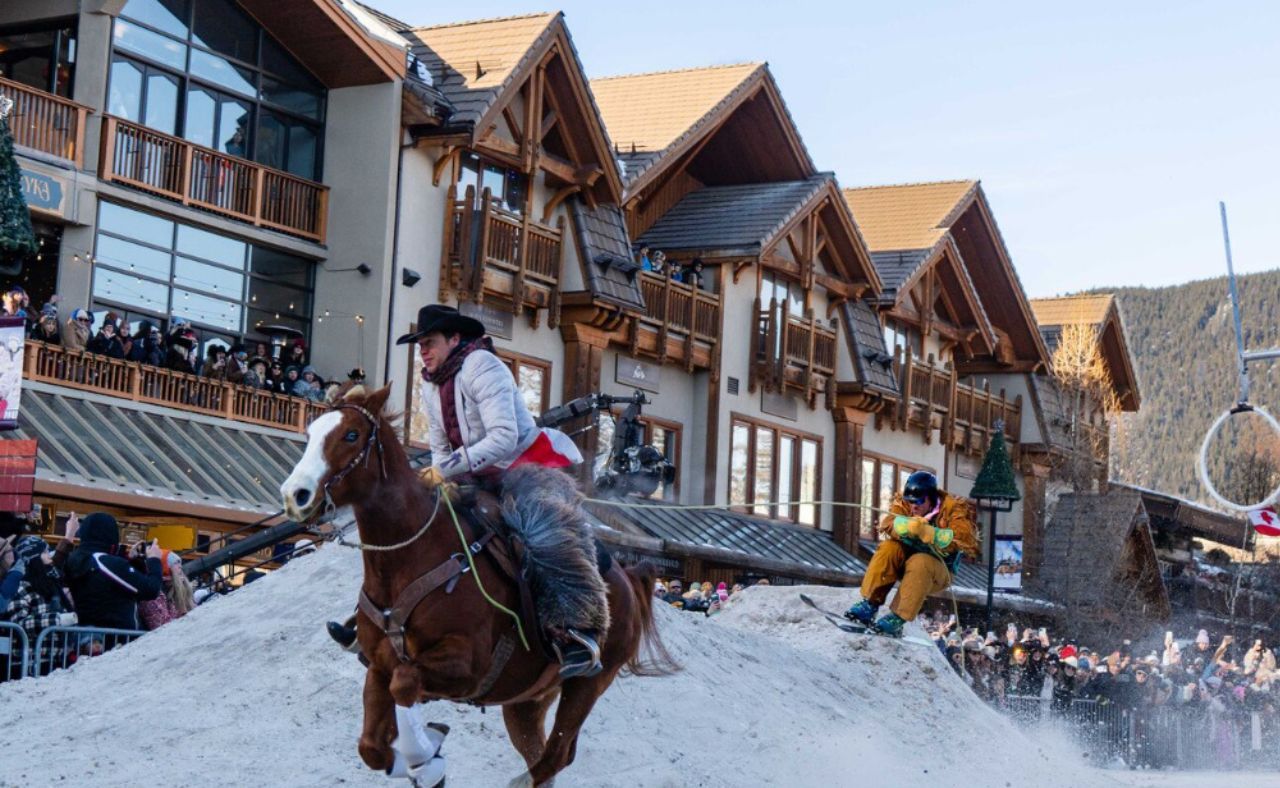
Record ridership on Roam Transit during Banff’s skijoring weekend in January showed strong demand for alternatives to driving, but the system’s fixed capacity and a surge of vehicles into town meant it could not keep pace with visitor volume.
On Saturday Jan. 17, Roam recorded 4,672 boardings, the highest daily total in its history, with ridership rising sharply across key routes, including a 71% increase in the Canmore-Banff corridor.
“The use of Roam showed that many people wanted to do the right thing and leave their personal vehicles parked and avoid parking challenges by taking the bus,” said Martin Bean, chief executive of Roam Transit.
Despite that increase, demand exceeded what the system could accommodate.
“Because Roam operates with fixed routes, with set schedules and maximum number of available seats on buses, the demand to ride Roam exceeded our capacity,” said Bean.
The strain on transit reflected broader pressures on Banff’s transportation infrastructure during the skijoring weekend.
According to the Town of Banff, about 23,900 vehicles entered the town on the Saturday of the event, slightly below peak summer levels of 24,000 vehicles per day, but much of that traffic was concentrated into short timeframes. Between noon and 1 p.m., 1,745 vehicles entered town, while 1,773 exited between 3 and 4 p.m.
That compressed influx created congestion across the road network, which in turn affected transit service. Because Roam buses operate in mixed traffic, they are subject to the same delays as private vehicles, limiting their effectiveness during peak periods. On-time performance dropped by approximately 25% compared to the previous weekend.
“The influx of personal vehicles in a short period of time created traffic congestion on our bus routes, affecting our on-time schedule,” Bean said.
Service was further affected by the design of the event itself. Seven bus stops were closed for the weekend, and the closure of Banff Avenue, one of Roam’s busiest corridors, required detours. Those alternate routes reduced system efficiency, diverting buses onto streets not designed for transit. Service was also disrupted by vehicles parked illegally along routes, creating additional delays.
“Event organizers and the Town worked with us to create detours for the bus service, but it is not as efficient as when there is not an event on the main street,” Bean said.
For residents, the weekend highlighted the limits of both infrastructure and planning. Mayor Corrie DiManno said the town was pushed to capacity as sidewalks filled, parking was exhausted by midday and emergency access became a concern. Vehicles spilled into residential areas, and residents reported being unable to access services or attend scheduled events.
In a town bounded by a national park, Banff’s infrastructure is inherently limited. Roads cannot be widened, parking cannot easily be expanded and pedestrian space is fixed within a compact 4.77-square-kilometre footprint. But demand on that system is global, driven by tourism, social media exposure and large-scale events that draw thousands of visitors at once. The skijoring weekend underscored that the challenge is not just transit capacity, but how events concentrate demand into short, intense periods that exceed what the town’s fixed infrastructure can absorb.
While transit is a critical tool in reducing reliance on personal vehicles, it cannot on its own resolve those broader pressures. Roam Transit says its system is designed for steady, predictable ridership and is not built to move large crowds within a short timeframe, with Bean noting that large events may require a different approach.
“While our resources allow us to provide some increased service during peak ridership periods, large events that require the movement of large crowds in a short time frame are better served by contracting buses for shuttles from the private sector,” he said.
As planning for future events continues, transit officials and municipal partners are expected to focus on whether changes to transportation, event design or capacity controls are needed to prevent similar pressures.

Reply