- Bow Valley Insider
- Posts
- Banff’s Skijor Traffic Was Not at Record Levels. So Why Did It Feel Like a Breaking Point?
Banff’s Skijor Traffic Was Not at Record Levels. So Why Did It Feel Like a Breaking Point?
“We were stretched to our limit,” Mayor Corrie DiManno said, describing a weekend that delivered economic gains while testing infrastructure, services and community tolerance

Bow Valley Insider
January 22, 2026
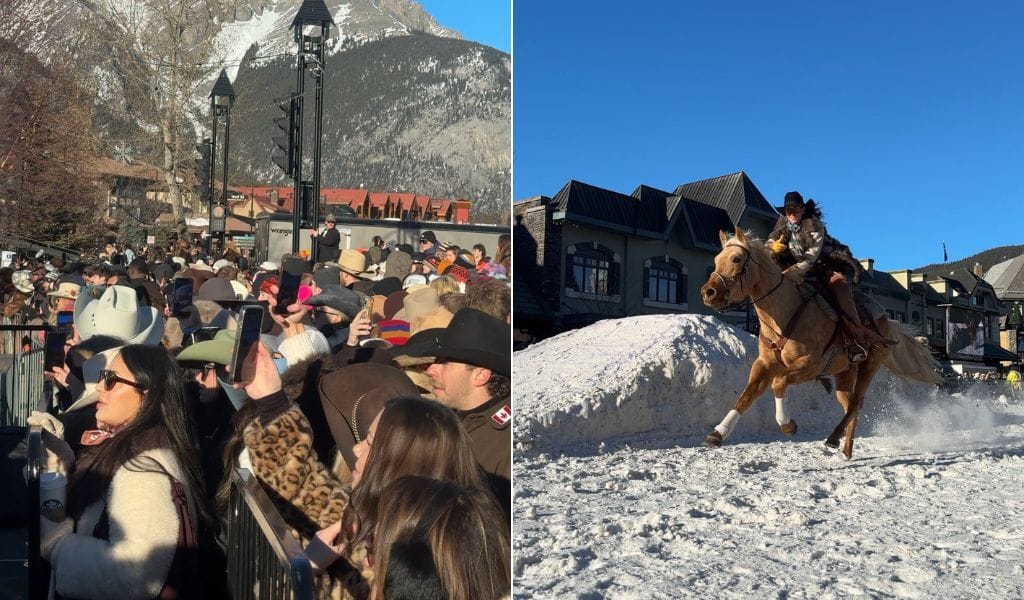
Shortly after noon on Saturday, Jan. 17, traffic on the Trans-Canada Highway east of Banff slowed to a crawl. Vehicles queued past the park gates and toward Canmore as thousands of people converged on Banff Avenue for the return of skijoring, the signature event of the Banff Lake Louise SnowDays Festival. Horses would thunder down the closed main street at 2 p.m., pulling skiers and snowboarders over jumps in a made-for-social-media blend of western culture and winter sport.
By mid-afternoon, sidewalks along the 200 and 300 blocks of Banff Avenue were packed shoulder-to-shoulder. Restaurants posted multi-hour waits. Municipal enforcement officers were writing parking tickets and calling tow trucks. Police were dealing primarily with public alcohol consumption. At the Banff East Gate, Parks Canada temporarily waved vehicles through without stopping to prevent traffic from backing up onto the highway and to preserve emergency access.
For many visitors, it was an unforgettable winter spectacle. For many residents, it felt uncomfortably close to the limits of what a 4.77-square-kilometre town in a national park can absorb.
The weekend has since become a case study in a tension Banff has been grappling with for years: how to balance economic vitality and destination marketing with finite roads, sidewalks, parking, emergency access, and community tolerance.
Not record traffic, but record compression
In the days after the event, social media and some early reporting described “record numbers of vehicles” in Banff. Town data tell a more nuanced story.
According to Jason Darrah, the Town of Banff’s director of communications, traffic counters at the two highway entrances recorded about 23,900 vehicles entering town on Saturday and 19,769 on Sunday, roughly 24% higher than the previous year’s Skijoring weekend. Those totals are below the town’s typical summer congestion threshold of about 24,000 vehicles per day, a level exceeded regularly in July and August.
What was different, Darrah said, was not the daily total but the timing.
“The hourly entrance and exit volumes were the highest we have ever recorded,” he said. Between noon and 1 p.m. on Saturday, 1,745 vehicles entered town, an all-time high for a single hour. Between 3 and 4 p.m., 1,773 vehicles exited, also a record.
“That kind of volume in a very compressed window is what creates strain,” Darrah said. “It affects parking, sidewalks, emergency access, and the ability to move people safely.”
The pattern reflected the structure of the event itself. With skijoring scheduled for 2 p.m. on a sunny Saturday, large numbers of day-trippers from Calgary and the Bow Valley arrived at roughly the same time and left soon after the races ended.
Sidewalks, parking and emergency access
From the town’s perspective, crowd density rather than overall attendance triggered the most immediate concerns.
Banff & Lake Louise Tourism, the event organizer, has estimated that about 10,000 people were in the skijoring area on Saturday, a figure still being refined through pedestrian counts and video analysis. Darrah said sidewalks adjacent to the course became over capacity shortly after 2 p.m., prompting event staff to actively move people to maintain flow and to keep an emergency access lane clear.
Inside the town, parking reached its limits early. The 500-stall free train station lot was full by 10 a.m. All other north-side lots and most on-street spaces were full by about 12:30 p.m. With legal parking exhausted, vehicles spilled onto residential streets, fire lanes, and private property.
Municipal enforcement issued 239 parking tickets over the two days and towed numerous vehicles. Even so, Darrah said, staff could not address every complaint of blocked driveways, hydrants and alleys in real time.
Mayor Corrie DiManno said it became clear by early afternoon that the town was being pushed to its limits.
“It became clear we were stretched to our limit on Saturday at about 1 p.m.,” she said. “Sidewalk capacity was close to full and people were still pouring in. Parking was already full, and you could see illegal parking and groups walking along roads before they even reached town.”
DiManno said the disruption went beyond inconvenience.
“We had a heartbreaking story about elderly folks unable to attend a funeral because there was no parking available in the private lot or for blocks around,” she said. “We heard from people trying to park at our Recreation Centre for a major tournament and they couldn’t participate.”
For DiManno, the situation felt unlike even the busiest summer days.
“In the small area around the course, the crowding was far more dense than on the busiest day in summer,” she said. “The number of vehicles exceeded our available space and created emergency access risks, as well as real distress for residents.”
Parks Canada, which manages the highway gates and has authority over traffic control at park boundaries, confirmed it intervened to keep vehicles moving.
Kelly Veillette, the agency’s public relations and communications officer for Banff National Park, said staff observed “increased traffic volumes and delays at the Banff East Gate” linked to the event. As part of standard operating procedures, vehicles were temporarily flagged through the gate “to support traffic flow and ensure emergency vehicle access on the Trans-Canada Highway.” Parks Canada also noted a high number of vehicles parked illegally in no-parking zones and along roadways.
A winter economic jolt
From the tourism and business side, the same conditions were seen very differently.
Kristina MacDonald, director of events and experience development at Banff Lake Louise Tourism, said skijoring “saw significantly higher attendance than prior years,” driven in large part by viral social media exposure.
“We are pleased with the strong visitor engagement and clear evidence of winter vibrancy in Banff,” MacDonald said. “Local businesses and their employees had a truly banner weekend in what has traditionally been a quiet time of year.”
MacDonald said the organization’s goal in hosting winter signature events is to generate overnight stays and stabilize employment outside the peak summer season. Early on-site surveys and online feedback, she said, show very high visitor satisfaction, particularly among those who planned ahead and booked accommodation.
Inder Singh, owner of the Subway restaurant in downtown Banff, offered a ground-level view of what that demand looked like.
Sales on skijoring weekend were about 50 percent higher than a typical January weekend, Singh said, though still below the levels seen on peak days in July and August. The rush began around 11 a.m. and lasted until roughly 8 p.m., with the store reaching capacity at lunch.
“We are always ready for this kind of rush,” Singh said. “Our staff step up whenever required.” He described most customers as day visitors from Calgary and said the event was “much needed” for winter business. “I think we need more events like this,” he said.
A divided public

To gauge local sentiment, Bow Valley Insider surveyed its readers in the days after the event, asking whether Banff should continue hosting skijoring. Of 651 respondents, 54.22% said the impacts outweighed the benefits, while 45.78% said the event was worth it.
The comments revealed a community almost evenly split, with a large middle group expressing a conditional view: support for the event in principle, paired with concern about scale, location, and management.
Some emphasized the economic lift. “It’s only for one weekend and it creates a lot of fun and great atmosphere,” one reader wrote. “The retailers, restaurants and hotels were full.” Another called it “a fantastic event” that provides “a much needed boost at a quiet time of year.”
Others focused on safety and livability. “Traffic was at a standstill in parts of the town,” one respondent said. “If there had been an emergency I hate to think what would have happened.” Several described blocked driveways, illegal parking and difficulty moving through crowded sidewalks with children or strollers.
A recurring theme was that the event may have outgrown Banff Avenue as a venue. Many suggested relocating skijoring to larger sites such as the Fenlands Recreation Grounds, industrial lands with shuttle service, or even locations outside the townsite altogether. Others proposed ticketing, capped attendance, park-and-ride systems and mandatory shuttles from Calgary or Canmore.
“It’s a great winter event,” one reader wrote, “but Banff doesn’t have the capacity for it. The impact on the park and the townsite is negative. I understand it helps the businesses, but it causes chaos.”
Transit and unanswered questions
Public transportation was central to many of those suggestions. Several attendees reported being unable to board full buses, adding to frustration among those relying on transit during peak periods.
Bow Valley Insider requested ridership and capacity data from Roam Transit, which operates bus service in Banff and Canmore, and asked whether riders were left behind at stops and what would be required to move crowds of this size in the future. Roam Transit did not respond by deadline.
In the days following the skijoring weekend, however, Roam Transit posted a public safety reminder on its official Instagram account stating that open alcohol is not permitted on its buses, urging riders to “Roam with care” and comply with the law. The post did not reference the skijoring event directly, but came amid widespread reports of public drinking and crowding across the town.
Bow Valley Insider also sought comment from Banff Hospitality Collective, which operates 16 downtown restaurants, on wait times, staffing pressures, and the sustainability of the current event model. The group declined to comment.
What “beyond capacity” means
For DiManno, the weekend underscored the need to think about capacity in more than just traffic counts.
“We have finite sidewalks, finite parking, a finite road network, a finite number of hotel rooms and restaurant seats,” she said. “We also have to think about emergency access, waste, wildlife corridors and the overall experience for residents and visitors.”
The town is now convening a multi-agency review with Banff Lake Louise Tourism, Parks Canada, Roam Transit, RCMP, emergency services and public works to assess what worked, what did not and what would be required to host an event of this scale safely in the future.
Options to be examined include ticketed access, relocation, mandatory park-and-ride, increased transit capacity, crowd limits and changes to event format. DiManno said the discussion will also feed into the town’s upcoming Human Use Management framework, an initiative aimed at defining desired outcomes for visitor use and the tools available to achieve them.
MacDonald said Banff Lake Louise Tourism is similarly focused on learning from the weekend. “There’s a lot to analyze, learn, understand and improve, especially related to traffic and flow,” she said. “We will work with our partners at the Town of Banff to reflect and consider what’s next for skijoring in Banff.”
A success and a stress test
In one respect, the weekend achieved exactly what its organizers intended. Hotels were full, restaurants were busy, staff earned strong tips, and Banff drew international attention in the middle of winter. In another, it functioned as an unplanned stress test of infrastructure and governance.
The data suggest Banff was not overwhelmed by sheer numbers so much as by simultaneity. Thousands of people, many of them day visitors, arrived and departed within the same narrow window for a single downtown event. The result was a level of crowding and congestion more typical of a major summer holiday, compressed into a few critical hours in January.
For a national park town with fixed boundaries and limited room to expand, that raises questions that go beyond skijoring itself. How should large-scale events be designed in places where roads, sidewalks, and emergency access cannot be widened? How much demand can be shifted from cars to transit in cold weather? And how should the costs and benefits of tourism be balanced when the economic upside is concentrated but the disruptions are widely felt?
As one Bow Valley Insider reader put it, capturing the tone of the debate, “It was far too successful.”
Whether skijoring returns to Banff Avenue in its current form, moves to a different venue, or is restructured around tickets and transit, the Jan. 17–18 weekend has already left a mark. It demonstrated both the power of winter events to fill hotels and the fragility of a system when popularity, weather, and timing align.
In that sense, it was, as many residents and officials now acknowledge, both a triumph and a warning.
Reply