- Bow Valley Insider
- Posts
- Wildlife Safety Training Expanding Across Bow Valley Tourism Sector
Wildlife Safety Training Expanding Across Bow Valley Tourism Sector
The Biosphere Institute program aims to train 500 staff and partner with 25 local businesses to reduce human-wildlife encounters

Bow Valley Insider
April 07, 2026
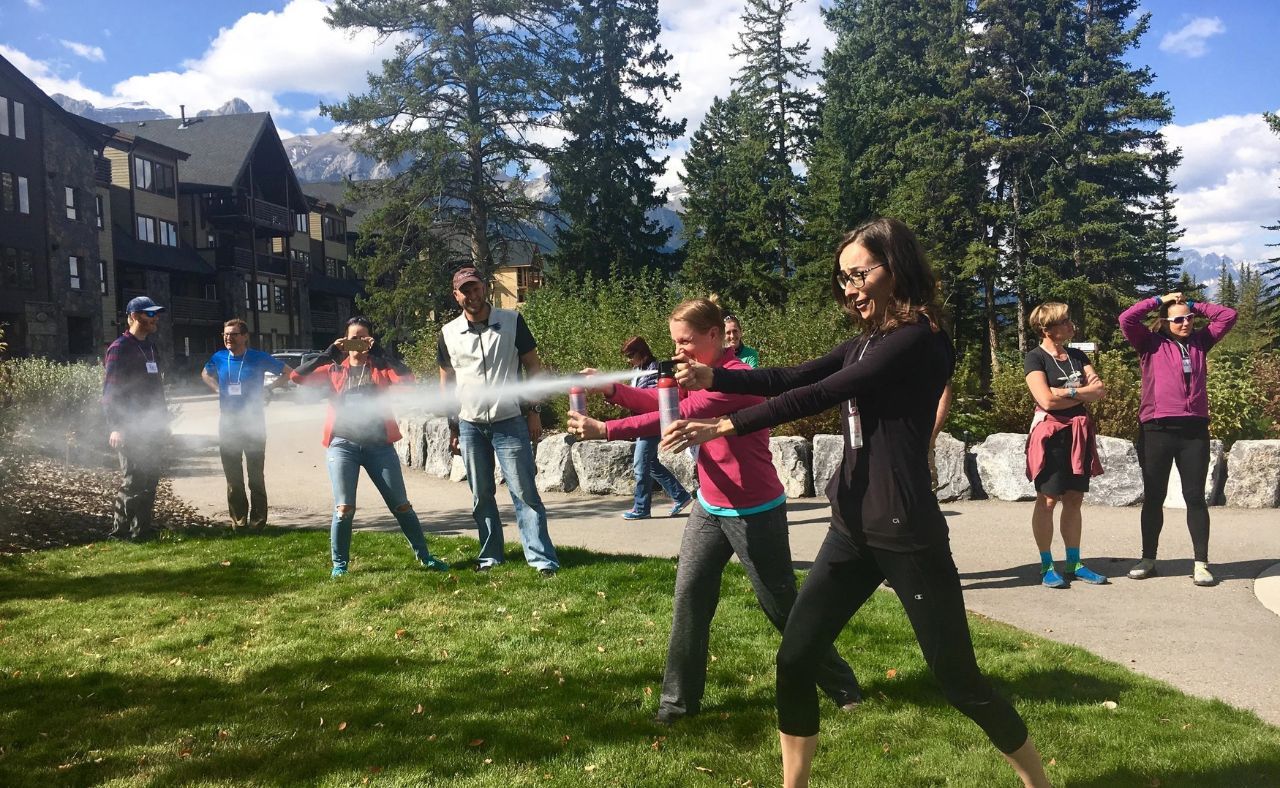
The Government of Alberta says the Biosphere Institute of the Bow Valley delivers wildlife safety education to more than 13,000 residents and visitors in the region each year, as the organization looks to expand the program through a new fee-for-service model.
According to the organization, its WildSmart program delivers education on attractant management, trail safety, and bear spray use through wildlife ambassadors, door-to-door outreach, and workshops, aiming to reduce human-wildlife conflict in a region that serves as a critical movement corridor for large mammals.
The organization is looking to expand the program through a fee-for-service social enterprise model aimed at generating revenue while extending its reach to tourism operators and visitors.
“Social enterprise is basically a profit venture that’s nested within a charity,” said Gareth Thomson, the organization’s executive director, during a Town of Canmore council meeting in January. “The work of the social enterprise must deliver on the goals and objects of the charity to stay within bounds for the Canada Revenue Agency.”
The expansion centres on a staff training program, known as Living Wild, aimed at hotels, outdoor recreation businesses and other tourism operators whose employees interact directly with visitors. The training covers local ecology, wildlife encounters and prevention strategies, followed by hands-on practice using inert bear spray. Participants who complete the training receive a certificate.
The program is already underway, with bookings open and early sessions completed. The organization aims to deliver at least 25 staff training sessions, train about 500 staff and establish partnerships with roughly 25 local businesses as it expands across the Bow Valley.
A separate visitor-focused educational component, known as Bear Necessities, is also under development. The program is designed as an interactive experience aimed at helping visitors understand how to safely and respectfully coexist with wildlife while in the Bow Valley. The organization says it is working with local tourism operators and businesses as partners in developing the program, with bookings expected to open later this year as those partnerships are finalized.
While the long-term goal of the social enterprise is financial sustainability, the organization says additional support is still required in the early stages, with operations continuing to rely on a mix of grants and donations.
The Town of Canmore continues to support WildSmart, and the organization said it is not currently seeking additional funding from municipal or provincial partners.
The Ministry of Forestry and Parks says the program has been part of broader wildlife management efforts since its formation in 2005.
“WildSmart leads diverse education and outreach efforts in this region of Alberta to raise public awareness and empower citizens to coexist safely with wildlife,” said Riley Gough, press secretary with the Ministry of Forestry and Parks.
Gough said the province most recently provided $25,000 annually in 2024 and 2025 through the Kananaskis Recreation Partnership Grant Program to support WildSmart’s community programming.
“The current funding and credibility they continually supply us with is enough to get our boots on the ground and begin our work educating locals and visitors,” said Jackie Kinney, an environmental educator with the Biosphere Institute.
Staffing remains limited, with two core team members delivering programming, though additional educators or coordinators may be required as the program expands.
Success, the organization says, will be measured through financial sustainability, expanded partnerships with local businesses and its ability to reduce human-wildlife conflict through education and awareness.
Targets include training 500 staff, engaging 500 visitors and establishing 25 business partnerships, while generating enough revenue to cover program costs and support ongoing work.
The organization says bookings for the Living Wild program are underway, with the visitor-focused Bear Necessities program expected to open in May.
To find out more, visit: https://www.biosphereinstitute.org/book

Reply