- Bow Valley Insider
- Posts
- Rare Wolverine Captured on Camera Near Canmore
Rare Wolverine Captured on Camera Near Canmore
Conservationists say the rare sighting highlights the importance of protecting wildlife movement through the Bow Valley.

Bow Valley Insider
January 24, 2026
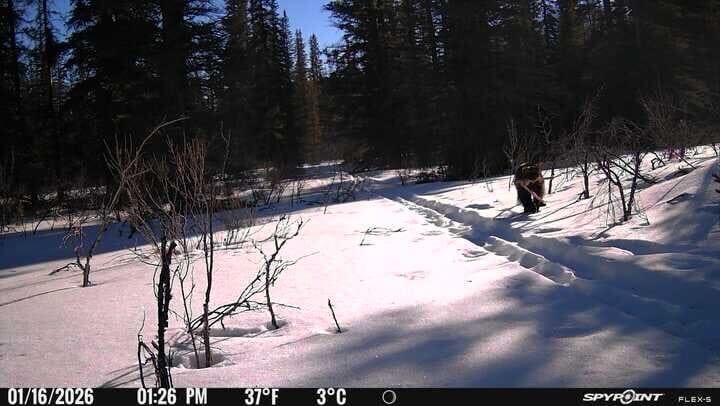
A rare wolverine spotted near Canmore is giving Bow Valley residents a reminder of how important the area is for wildlife moving through the Canadian Rockies.
The Yellowstone to Yukon Conservation Initiative (Y2Y), a Canmore-based conservation group, shared the sighting on Facebook after a remote wildlife camera captured the animal in an undisclosed location in the Bow Valley.
“Wolverines are a rare sight, and spotting one near a town as busy as Canmore is almost unheard of. But this recent photo proves something vital,” Y2Y wrote in the post.
Wolverines tend to stay away from places with lots of human activity, said Nikki Heim, a biologist with Y2Y.
“Wolverines are very wary animals, meaning they are highly sensitive to human disturbance ranging from human-caused changes to habitat to groups of hikers or skiers moving about the landscape,” Heim said. “So, where we still have wolverines, we still have some wild spaces.”
Heim said camera-confirmed sightings remain uncommon in this area.
“There have been occasional anecdotal sightings over the years, but few detected by camera, particularly in the valley bottom and east of the Banff National Park boundary,” Heim said.
The sighting also points to the Bow Valley’s role as a travel route for wildlife that needs large areas to survive, she said.
“This sighting reminds us of the importance the Bow Valley plays as an integral and central ecological corridor within the Yellowstone to Yukon region, particularly for species with vast range requirements such as wolverines,” Heim said. “This highlights how working to conserve and responsibly manage wildlife corridors can ensure we keep species, such as wolverine, persisting into the future.”
Heim said animals like wolverines use the Bow Valley as a path through the mountains. When people protect those paths, wildlife can keep moving safely between larger wild areas.
“We rarely detect wolverines moving through the busy valley in and around Canmore,” she said. “However, it is important to use this sighting as an indicator that we have not yet squeezed them out.
Heim also said climate and development can affect where wolverines travel and how well they survive.
“Wolverines have been found to be negatively impacted by the cumulative effects of human development, human-caused landscape change and climate within this region,” Heim said. “Human development and climate can affect their movement, where they occur, and their population numbers.”
Y2Y does not currently monitor wildlife in high-use recreation areas, Heim said, but the group supports work that improves understanding of how people and wildlife share the same spaces.
For residents and visitors, Heim said the sighting is a reminder to keep wildlife in mind year-round, even when animals are out of sight.
“Residents and visitors can keep in mind the importance and uniqueness of this valley where humans and wildlife continue to coexist, and that small actions towards recreating responsibly can make a big difference to ensure the most sensitive wildlife continue to thrive,” Heim said.
She said people can also help by staying consistent and predictable outdoors.
“Predictability is key,” Heim said. “Wary wildlife will adapt to our activities if they can predict where and when we will be sharing the landscape.”
Ways residents and visitors can increase their predictability and recreate responsibility are:
Learn about the wildlife in your area and respect their needs.
Never approach. If you come across an animal, STOP and give them lots of space.
Recreate during the day, as animals often feed and move during the dawn and dusk and into the nighttime hours.
Respect trail closures and stay on trail.
Limit accessing remote areas that can be used as safe havens for wildlife.
Leave no trace by camping in designated sites and pack out what you pack in.
Secure food and other attractants with bear-proof canisters or hang it from a tree.
Keep dogs on leash.
More information about the group’s work in the Bow Valley is available at:
https://y2y.net

Reply