- Bow Valley Insider
- Posts
- Nearly a Year Later, Report Explains Why a Kicking Horse Gondola Cabin Fell
Nearly a Year Later, Report Explains Why a Kicking Horse Gondola Cabin Fell
The investigation outlines how a small crack, repeated impacts and cold-weather steel properties combined in the March 2025 incident.

Bow Valley Insider
February 19, 2026

Just after 9:20 a.m. on March 10, 2025, a gondola cabin at Kicking Horse Mountain Resort near Golden, B.C., fell to the ground shortly after leaving the base station.
The cabin, which can carry up to eight passengers, had just begun its climb when the metal arm connecting it to the cable broke. The cabin dropped about 1.5 meters and landed on its side.
All eight passengers were able to exit the cabin. Minor injuries were reported.
The lift was immediately stopped. Guests in other cabins were left suspended along the line. An initial attempt was made to restart the gondola to unload passengers normally, but part of the broken arm became stuck in the system. Resort staff then switched to a manual rope evacuation.
It took approximately 7.5 hours from the time of the failure until the final passengers were brought down safely.
Nearly a year later, Technical Safety BC has released its investigation into what caused the failure.
The broken arm was a single point of failure
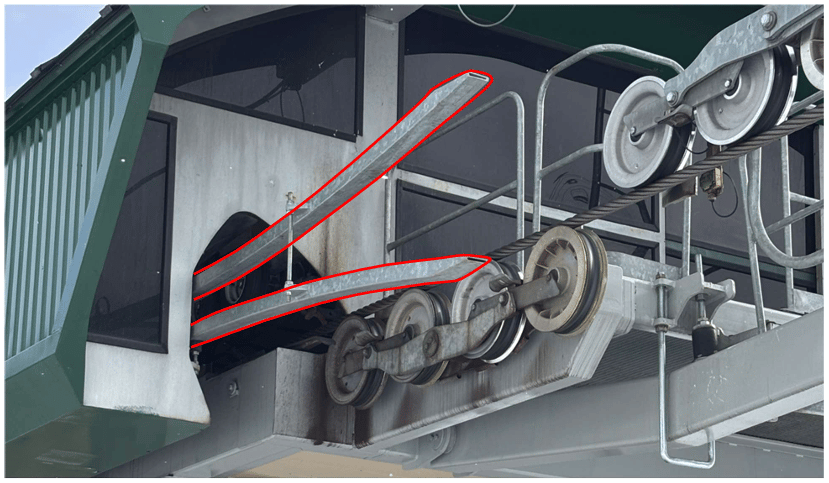
The part that failed is known as a hanger arm. It is the curved metal piece that connects the gondola cabin to the moving cable above.

The area of the failure was near a noted check point and is highlighted
There is no backup if it breaks.
The report describes the hanger arm as a critical component. If it fails, the cabin detaches.
These arms are designed with a safety margin built in. They are required to be strong enough to handle at least three times the normal weight they carry. In addition, they are subject to regular inspections.
The investigation found that the failure was caused by a crack that had developed in the metal and eventually grew large enough for the arm to snap.
The crack likely began years earlier
Investigators determined the crack likely started at or shortly after the hanger arm was manufactured in 2000.
The arms were made from a type of structural steel that did not include specific requirements for how the material performs in very cold temperatures. The steel tubing was bent into shape while cold, then coated in zinc through a galvanizing process.
Testing after the incident showed that in the bent section of the failed arm, the metal had become unusually brittle. Instead of bending and flexing under stress, it was more prone to cracking.
The report found that the combination of the original steel selection, the bending process and the galvanizing likely reduced the toughness of the metal in that curved section.
Over time, a small crack formed. It remained small for years.
But it did not stay that way.
Repeated impacts likely made it worse
The investigation found that gondola cabins at Kicking Horse had experienced rough entries into stations for years.
When a cabin enters a station slightly sideways, often due to wind or uneven loading, guide rails are meant to straighten it. If the alignment is not perfect, the hanger arm can strike part of the station structure.
About 60% of the hanger arms inspected after the incident showed signs of past impacts.
The failed arm had a noticeable dent at the top, suggesting it had struck the station at least once, possibly more.
Investigators concluded that one or more of these impacts likely caused the crack to grow.
In simple terms, the metal was already vulnerable, and a hard strike may have accelerated the damage.
Inspections did not detect the crack
The hanger arm that failed had been inspected multiple times in recent years.
It underwent non destructive testing in 2020, 2021 and 2023. Those inspections did not identify any cracks.
The report suggests several reasons why the crack may have gone undetected.
Early on, it may have been hidden beneath the galvanized coating. The crack began in the inside curve of the bend, an area that is difficult to see and often covered in snow and ice during winter inspections.
Magnetic particle testing, the method used, is effective but not perfect. The window between when the crack became large enough to detect and when it reached critical failure may have been relatively small. The report estimates the crack was about 18 millimetres long before it fractured suddenly.
Even though inspection frequency met and in some cases exceeded code requirements, the crack was not identified before it reached that point.
Investigators say it was a rare convergence
Technical Safety BC tested dozens of other hanger arms from the same lift, as well as similar lifts elsewhere. No other cracks of this nature were found.
The report concludes the failure was not caused by a single factor, but by an unusual combination of steel selection, manufacturing changes, repeated impacts and long term crack growth.
Investigators describe it as an unlikely convergence of several abnormal conditions.
New recommendations for manufacturers and operators
The report includes several recommendations aimed at manufacturers and lift operators.
Manufacturers are urged to use steel with clearly defined low temperature toughness properties when building critical components like hanger arms. They are also encouraged to review other lifts built with similar materials and consider whether inspection intervals or testing procedures should be updated.
Operators are advised to treat any significant impact between a cabin and station as a serious event and remove affected carriers from service until additional testing is completed.
What it means for skiers
For many Bow Valley skiers, Kicking Horse is a regular destination. The Golden Eagle Express gondola is the main access to the upper mountain in both winter and summer.
The investigation makes clear that gondola systems are built with multiple layers of safety, including structural design margins and regular inspections. It also shows how complex systems can be affected by small details over time.
On the day of the incident, despite the structural failure, all passengers were evacuated safely. Conditions were favourable and trained staff, along with search and rescue personnel, completed the operation without serious injury.
The report closes one chapter in the incident. Its broader impact may depend on how manufacturers and operators respond to the recommendations in the years ahead.
Reply