- Bow Valley Insider
- Posts
- Fish Disease Spreads Across Rockies, Triggers New Lake Restrictions
Fish Disease Spreads Across Rockies, Triggers New Lake Restrictions
New detection in Lake Louise prompts tighter controls on boating and fishing across Banff, Yoho, Kootenay and Waterton

Bow Valley Insider
April 19, 2026
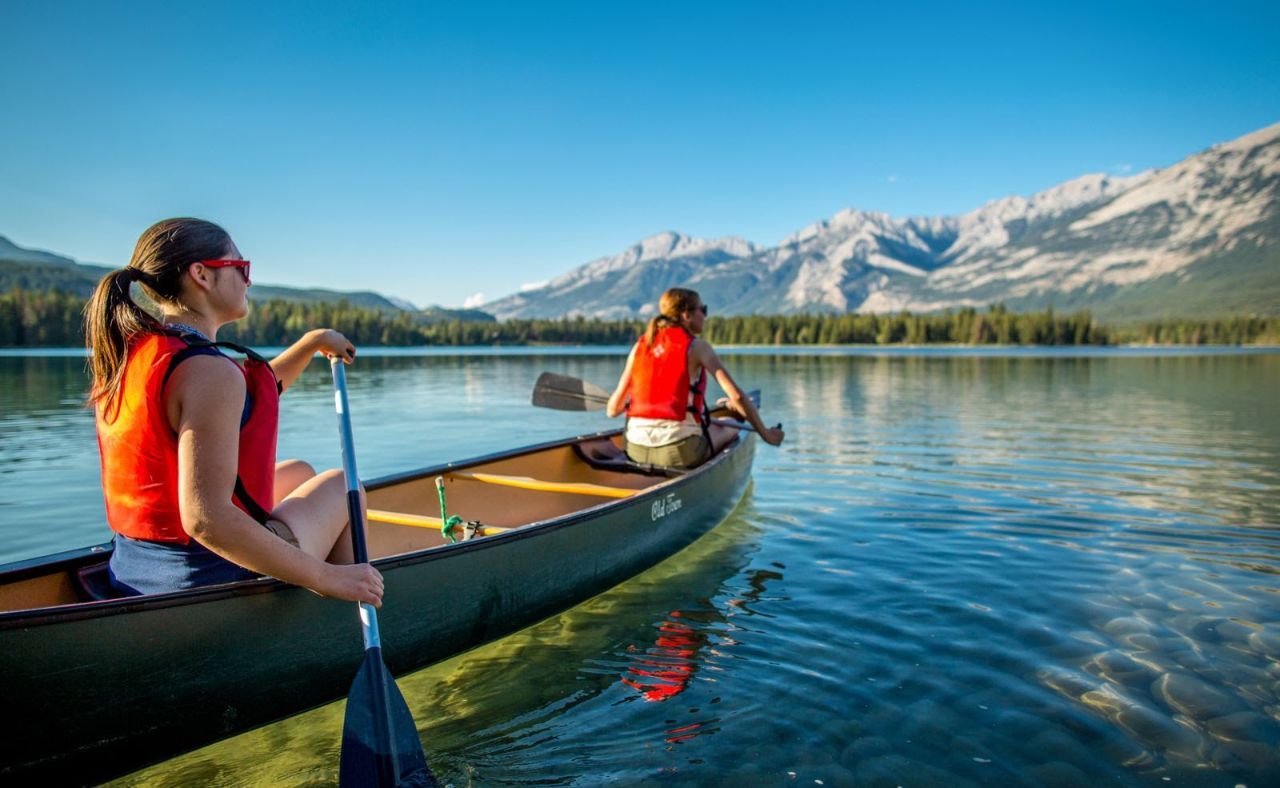
Parks Canada is tightening restrictions on lakes and rivers across Canada’s Rocky Mountain national parks as aquatic invasive species spread across the region, including a new detection of whirling disease in Lake Louise.
The agency confirmed whirling disease, an infectious parasite that can devastate trout and other fish populations, was detected in Lake Louise and Louise Creek in 2025, marking the latest development in a regional spread that has been ongoing for nearly a decade.
“Since the first detection in the region in 2016, we have seen an increasing spread of whirling disease,” Parks Canada said in a joint written response from Banff, Yoho and Kootenay, and Waterton Lakes field units.
Whirling disease affects trout, whitefish and salmon and can cause severe deformities and high mortality in young fish, with impacts reaching as high as 90% in some cases. While it poses no risk to humans, it can have long-term consequences for aquatic ecosystems and recreational fisheries.
Parks Canada said the parasite has now been confirmed in multiple waterbodies across the mountain parks, including the Bow River downstream of Lake Louise and the Spray River in Banff, as well as several waterbodies in Yoho and the Belly River watershed in Waterton Lakes National Park.
The detection in Lake Louise is particularly significant because of its connection to the Bow River system.
“Lake Louise is part of the Bow River watershed and any introduction has the potential to spread downstream,” Parks Canada said. “Water from Lake Louise flows into Louise Creek that drains into the Bow River, where whirling disease has already been detected within and outside of Banff National Park.”
Officials say the spread is being driven in part by human activity, particularly the movement of watercraft and gear between lakes and rivers.
“Due to high visitor use in Lake Louise, human-mediated factors such as recreational activities like angling and boating pose a higher risk of transporting whirling disease to uninfected locations,” Parks Canada said.
In response, Parks Canada is rolling out the next phase of a region-wide Aquatic Invasive Species (AIS) Prevention Strategy this spring, introducing stricter controls on water-based recreation across Banff, Yoho, Kootenay, Jasper and Waterton Lakes national parks.
The updated framework divides lakes and rivers into zones with varying levels of restriction, including areas where watercraft and fishing waders, which are waterproof gear worn by anglers, are prohibited to protect sensitive ecosystems.
Since 2017, the agency has relied on a combination of monitoring, inspections, permitting and public education to limit the spread of aquatic invasive species, but officials say those measures have not fully contained the disease.
“Inspection and decontamination programs alone cannot eliminate the risk of introduction and are costly to operate at the scale required,” Parks Canada said, noting compliance among non-motorized users has remained “consistent at about 60%.”
That gap, combined with continued detections, prompted a shift toward stricter, location-specific restrictions. Parks Canada said the zoning decisions were based on an assessment of over 400 waterbodies, taking into account ecological sensitivity, visitor use and the potential consequences of an invasive species introduction.
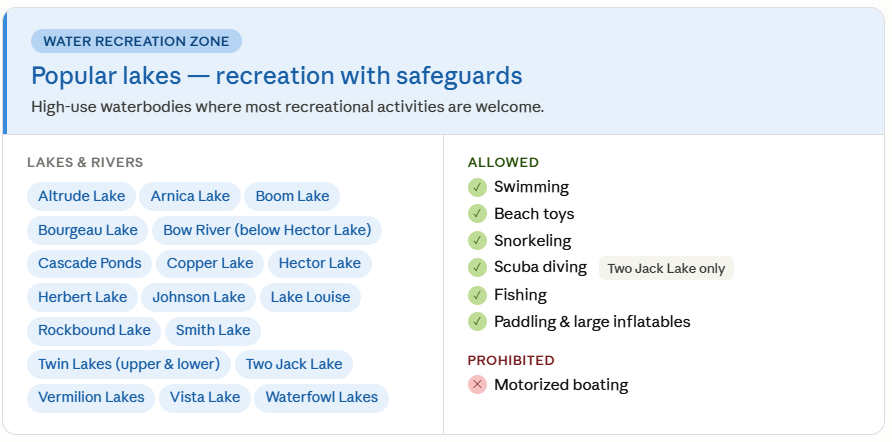
Under the new system, waterbodies are categorized as Water Recreation Zones, Water Preservation Zones, or Special Tactics Zones.
Water Recreation Zones, which include Lake Louise, Cascade Ponds, Vermilion Lakes, and Two Jack Lake, will continue to allow most activities, provided users follow mandatory decontamination practices such as cleaning, draining and drying all equipment between uses.
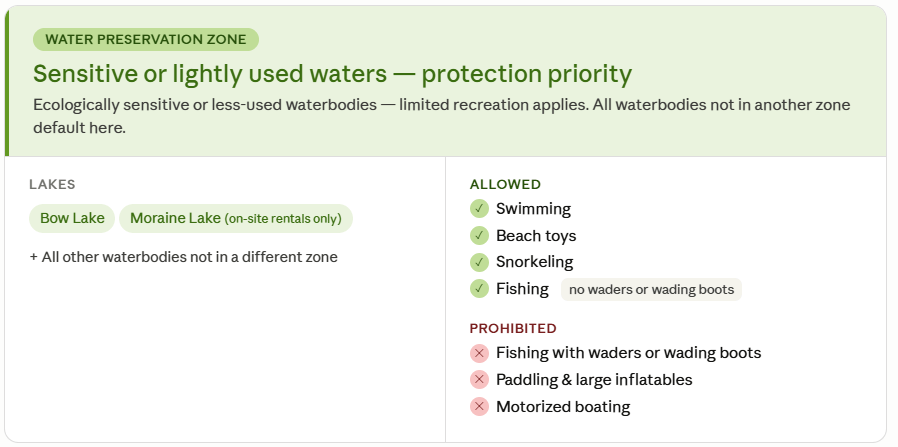
Water Preservation Zones, typically located in ecologically sensitive areas, prohibit watercraft and fishing waders entirely to reduce the risk of introducing invasive species.
Moraine Lake, Bow Lake, and Peyto Lake, among others, have been placed in a Water Preservation Zone due to their ecological importance and role in planned fish restoration efforts, meaning personal watercraft and similar equipment are not permitted.
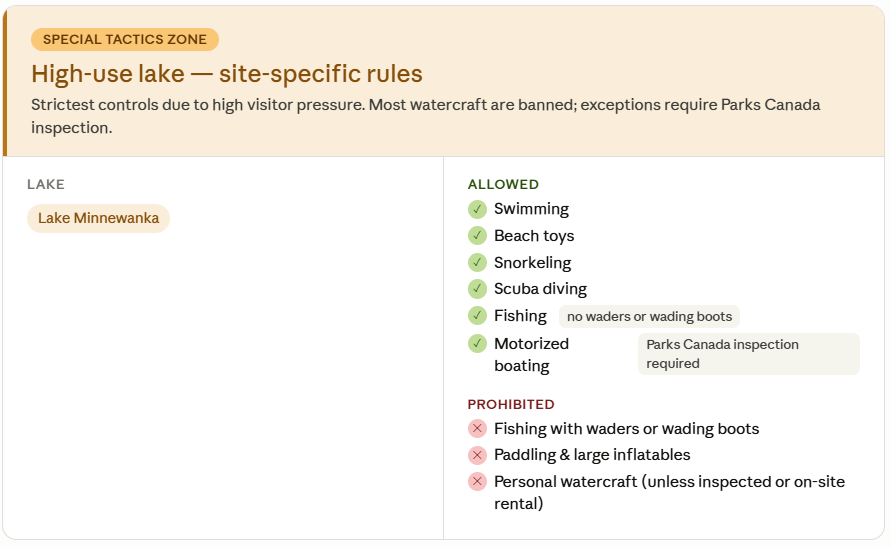
Special Tactics Zones apply tailored rules to more complex waterways, balancing ecological protection with limited recreational use, which at this time, only includes Lake Minnewanka.
Parks Canada emphasized that even lakes without confirmed detections cannot be considered disease-free.
“A negative test result does not necessarily confirm the waterbody is free of whirling disease; only that the parasite causing the disease was not detected in the sample,” the agency said.
Monitoring has expanded in recent years to include environmental DNA sampling, which detects traces of species in water, as well as shoreline surveys and canine detection using trained dogs.
Officials say prevention remains the most effective long-term strategy.
The agency also pointed to additional emerging threats, including proliferative kidney disease, which was confirmed in fish samples in Banff in 2025, and the growing proximity of invasive mussels to the mountain parks.
The new rules will be enforced through a combination of education, inspections and penalties, with violations carrying fines of up to $25,000 under the Canada National Parks Act.
Visitors will be required to understand which zone applies to each waterbody, follow equipment restrictions and, in some cases, obtain permits before engaging in water-based activities.
Parks Canada says visitors can find zone information through park-specific websites, with signage and staff outreach expected to guide compliance on-site.
At the Fairmont Chateau Lake Louise boathouse, operators say existing safeguards allow those activities to continue and that operations are not expected to be affected by the new restrictions.
“On-site watercraft rentals that do not leave the lake pose no risk of spreading aquatic invasive species, like whirling disease. Lake Louise is in the Water Recreation Zone, and most water activities may continue with existing safeguards in place,” said Anastasia Martin-Stilwell, regional director of public relations for Fairmont Hotels & Resorts and Rimrock Banff.
Parks Canada said commercial operators will continue to be permitted to operate, provided they meet decontamination and equipment-handling standards as part of their licensing requirements, although some may need to shift activities to different waterbodies depending on zoning restrictions.
The AIS Prevention Strategy will be rolled out in phases over the next two years, with additional details on permitting and regional alignment expected as the rollout continues.

Reply