- Bow Valley Insider
- Posts
- The Bow Valley Could Lose Up to 37 Days of Winter by Century’s End, Scientists Say
The Bow Valley Could Lose Up to 37 Days of Winter by Century’s End, Scientists Say
What climate models mean for skiing, guiding, and the Bow Valley’s outdoor economy

Bow Valley Insider
January 05, 2026
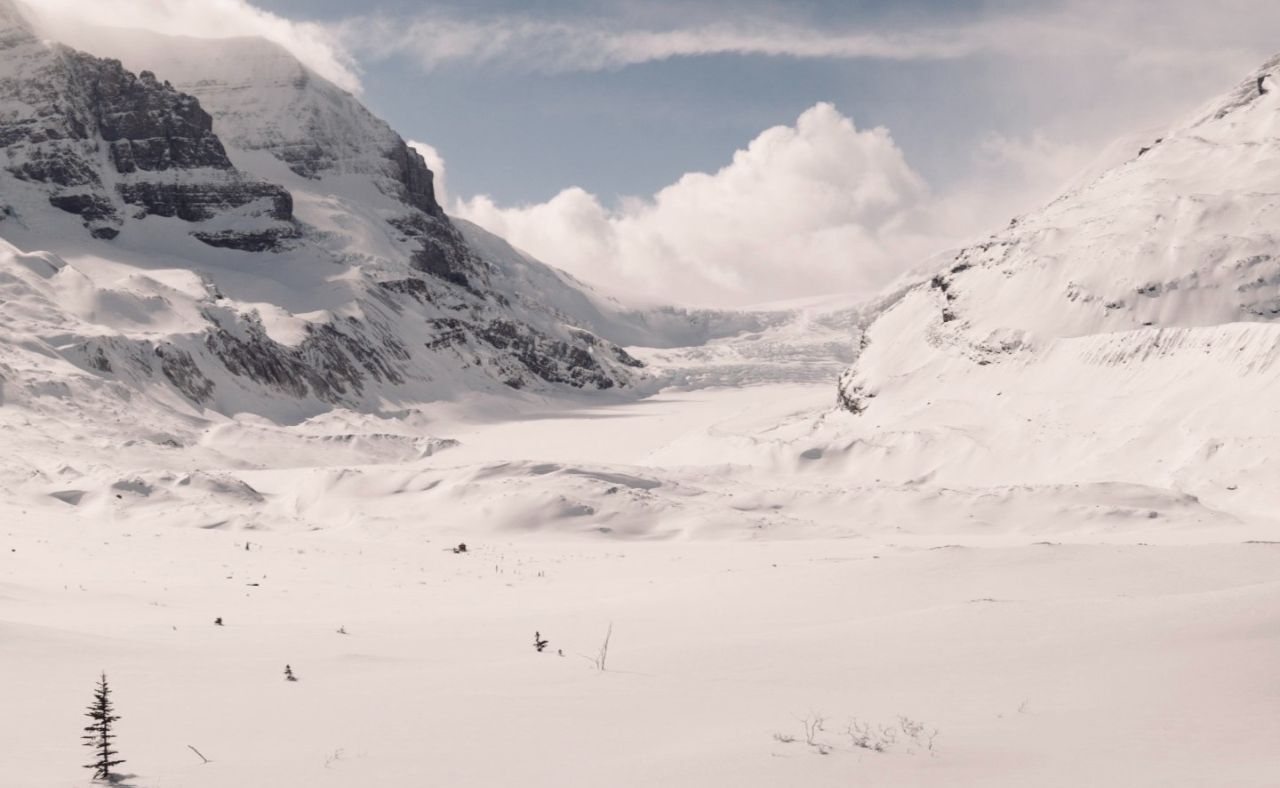
On December 8, an audience in Canmore gathered for an Earth Talks presentation hosted by the Biosphere Institute of the Bow Valley to examine how climate change is reshaping winter in the Bow Valley, and what that means for local economies, recreation, and community life.
The speakers, Stephanie Korolyk, community advocacy manager for Protect Our Winters Canada, and Dr. Marc Pons, a snow and avalanche scientist based in the Bow Valley, laid out a reality that many locals already feel but rarely see stitched together so clearly. Winter is changing faster in mountain regions than almost anywhere else on Earth, and the Bow Valley sits directly in that acceleration zone.
“The mountains are warming 25 to 50 percent faster than the global average,” Pons told the audience. “We are experiencing the changes much more than other areas, and this trend is expected to get worse.”
That speed matters, not just for snowpack and ski seasons, but for how entire communities function.
A winter economy hiding in plain sight
Korolyk opened by situating winter not as a niche concern, but as part of a massive, and often undercounted, economic engine. According to Protect Our Winters’ recent outdoor recreation economic report, outdoor recreation contributes more than $101.6 billion annually to Canada’s economy and supports over one million full-time equivalent jobs. That puts it ahead of forestry and close to oil and gas.
Even that figure, she said, is conservative.
“There’s a lot of missing data,” Korolyk explained. “So the number we’re talking about is definitely underreported.”
For places like the Bow Valley, where tourism, guiding, ski operations, retail, and service work are tightly interwoven, those numbers are not abstract. When conditions change, the effects ripple outward quickly. Korolyk pointed to Jasper’s recent wildfire as an example, noting how devastation spreads beyond the burn perimeter through canceled trips, relocated workers, and stressed businesses.
“When you start pulling one thread, it’s pretty incredible how much shifts across the region,” she said.
Warming winters, shorter seasons
Pons took the audience deeper into what climate models project for the Bow Valley specifically. In a high-emissions scenario, which he noted reflects the trajectory the world is currently on, average temperatures in the region are expected to rise by more than four degrees Celsius by the end of the century.
Precipitation may increase slightly, but higher temperatures change how and when that moisture falls.
“We might see more snow in the middle of winter,” Pons said. “But because of the temperature increase, especially at the beginning and end of the season, we expect a reduction of the snow cover period.”
By the end of the century, the Bow Valley is projected to have 26 to 37 fewer days each year with reliable snow cover, depending on how much warming occurs.
Some changes are subtle year to year. Others are impossible to miss. Pons showed paired images of Bow Valley landscapes from 1922 and 2022, where retreating glaciers and rising treelines served as what he called “sentinels.”
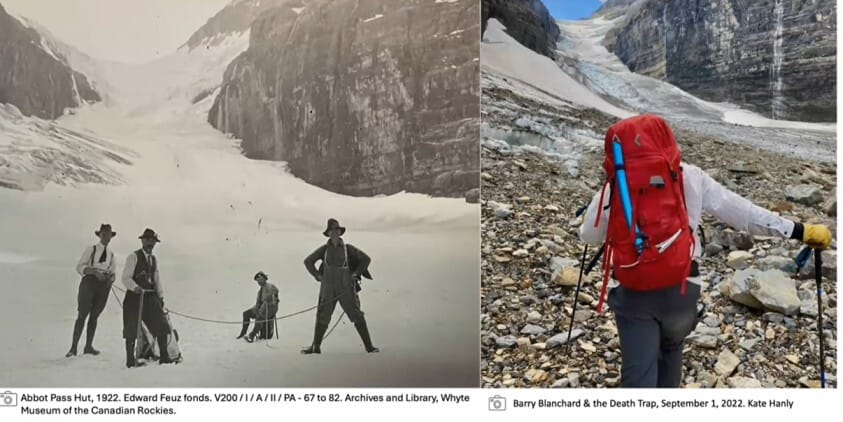
“There’s no space for doubt when you have this kind of evidence,” he said.
Guides on the front lines of change
Among the most immediate impacts are those faced by mountain guides, who spend more time in winter terrain than almost anyone else. Pons cited local research examining how climate change is already altering guiding practices in the Bow Valley.
The findings were striking. 90% of guides surveyed reported objective changes in mountain hazards. 85% said they were altering the length or timing of their guiding seasons. 63% reported changes in route character, and half said they had changed how they access terrain.
Adaptation, it turns out, is already universal.
“100% of them are doing some kind of temporal or spatial substitution,” Pons said. “They are changing when they go, or where they go.”
Many are also changing what they guide. 83% reported shifting the types of activities they offer, while 83% said they now spend significantly more time planning trips to manage increasing risk.
These are not distant projections. They are operational decisions being made right now.
The rise of mid-winter instability
Climate change does not just mean less snow. It also means different snow.
Pons described a growing pattern of rain-on-snow events and wet-snow avalanche cycles occurring in mid-winter, conditions that historically belonged to late spring. He showed an example from the Alps, where a major wet-snow avalanche cycle occurred in February rather than March or April.
“This is really unusual,” he said. “But now, because of climate change, we’re getting this more and more often.”
Using anonymized mobile phone data from a European natural park, researchers tracked how people altered their terrain choices during these events. When instability increased, recreationists shifted away from complex terrain toward lower-risk areas.
The implication for the Bow Valley is clear: climate change is reshaping not just where people go, but how they move through winter landscapes and how risk must be managed.
Skiing’s paradoxical future
When people think about winter and climate change, ski resorts are often the first thing that comes to mind. The picture is usually bleak. Pons’ data complicates that narrative.
Across Canada, ski season length is projected to decline, but not evenly. Alberta and British Columbia sit among the most climatically resilient regions, with projected reductions of roughly 4-8%, assuming advanced snowmaking capacity.
“That’s not that bad,” Pons said. “We can consider ourselves among the most resilient across Canada.”
Resilience, however, does not mean stability.
Pons described a paradox observed in long-term ski data. In one resort, the poorest snow year in a 16-year period produced the highest skier numbers. One of the best snow years delivered some of the worst attendance.
Snow conditions alone do not determine visitation. Travel patterns, destination substitution, marketing, and calendar timing all play major roles. In surveys of skiers across North America and Europe, only 5% said they would stop skiing altogether if their home resort closed. The remaining 94% said they would ski somewhere else or at a different time.
“That doesn’t mean there are climate winners and losers,” Pons cautioned. “That’s what some of the industry is thinking right now, and it’s not exactly like that.”
For the Bow Valley, increased reliability could mean increased pressure. More visitors. More transportation emissions. More strain on housing, wildlife corridors, and infrastructure.
“In my opinion,” Pons said, “one of the biggest challenges we will have here will be transportation sustainability.”
Advocacy in a crowded field
Korolyk closed the evening by shifting from impacts to action. Protect Our Winters Canada, she explained, is a nonpartisan, science-based organization that works on policy and advocacy by mobilizing outdoor enthusiasts. The organization has grown to more than 41,000 members nationwide, supported by alliances of athletes, scientists, retailers, and resorts.
Still, she acknowledged the scale of the challenge.
“In 2023, the fossil fuel industry reported over 1,200 lobby meetings in Ottawa,” she said. “We might be able to do one trip a year.”
What POW tries to bring, Korolyk said, is collective voice. She pointed to what researchers call the “perception gap,” where people underestimate how many others share their concerns. In Canada, 69% of people say they are worried about climate change impacts in the next five years, and 76% are concerned about future generations.
“People do care,” she said. “They’re just not always speaking up.”
Local chapters, including POW’s Bow Valley chapter, focus on municipal-level action, where Korolyk said as much as 70% of climate-related policy tools can exist through bylaws, resolutions, and planning decisions.
As the evening wrapped up, attendees were invited to write postcards to the prime minister, sharing personal stories about winter and why it matters to them. It was a small gesture, but one rooted in the premise that winter’s future in the Bow Valley will be shaped not just by climate models, but by the choices communities make long before the snow disappears.
Reply