- Bow Valley Insider
- Posts
- Rare Owl and an Unexpected Robin Surge Mark the 2025 Bow Valley Bird Count
Rare Owl and an Unexpected Robin Surge Mark the 2025 Bow Valley Bird Count
Nearly 4,000 birds were counted across Banff and Canmore during the week-long December survey, including first-time sightings and unusually high winter robin numbers

Bow Valley Insider
January 03, 2026

A long-eared owl, a species rarely seen in winter, was recorded for the first time on Canmore’s Christmas Bird Count list during the 2025 Bow Valley survey.
The most unusual results from the 2025 Banff-Canmore Christmas Bird Count were not the birds residents commonly associate with winter in the Bow Valley.
They were the exceptions.
The Canmore team recorded a long-eared owl, a species that had not previously appeared on Canmore’s Christmas Bird Count list.
In the Lake Minnewanka area, observers spotted a long-tailed duck, a bird that nests in the Arctic and is rarely seen inland during winter. While a long-tailed duck had been observed once before in spring near Cascade Ponds, this marked a first for the team covering that section of the count.
These rare sightings stood alongside a year that, overall, produced some of the strongest numbers seen in the Bow Valley in recent memory.
A Count With High Participation
The Banff-Canmore Christmas Bird Count has been organized by the Bow Valley Naturalists since 1975 and is part of a continent-wide citizen science effort that dates back to 1900. Each count surveys birds within a fixed circular area, allowing results to be compared year over year.
In 2025, 83 volunteers participated, split roughly evenly between Banff and Canmore. Observers formed 36 field teams, with two feeder watchers monitoring birds at backyard feeders in Canmore.
“It was a great turnout of seasoned participants and new to the Count and birding,” wrote Heather Dempsey, coordinator for the Banff bird count. “Warm calm weather always helps too.”
Observers recorded 44 species on the day of the count, with an additional five species documented during Count Week, a three-day window on either side of Count Day used to capture species present in the area but missed during the official count.
Nearly 4,000 Birds Recorded
While the number of species was in line with recent years, the total number of birds counted stood out.
Observers recorded 3,987 individual birds, the highest total since 2018 and one of the strongest counts in the 2009–2025 record. That total was achieved without an increase in overall distance covered by teams, indicating birds were more concentrated or more easily found than in many recent years.
The result suggests that conditions in 2025 favored both bird presence and detectability across the Bow Valley.
The Robin Spike
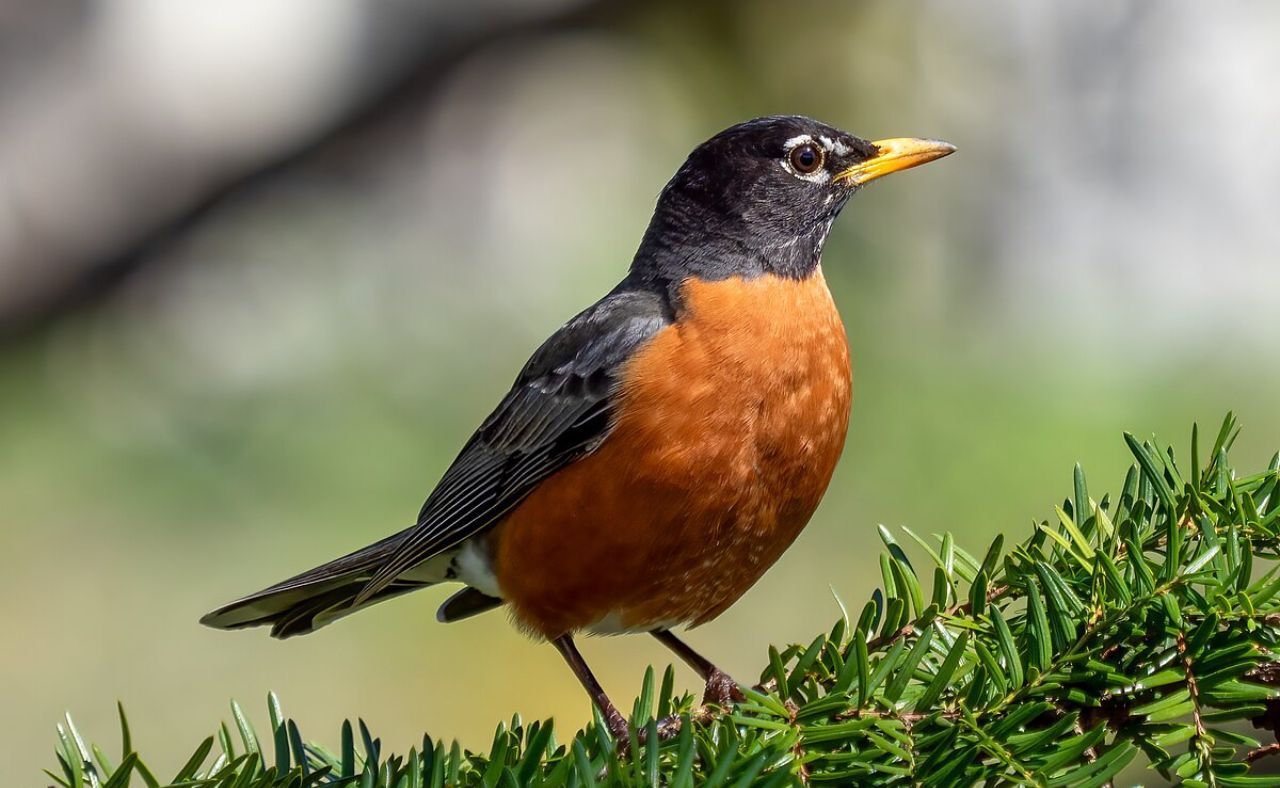
American Robin
One of the most striking results was the number of American robins recorded.
In most years, robins are either absent from the Banff-Canmore Christmas Bird Count or appear only in very small numbers. In 2025, observers counted 112 robins, a dramatic departure from the long-term pattern.
“A well-known trend is that birds follow the food,” Dempsey wrote, “especially the seed eaters, like members of the finch family.”
Robins are considered partial migrants. While many migrate south for winter, others remain farther north if food is available. When insects and worms disappear, robins shift to berries and fruit, and their winter distribution can change quickly.
Dempsey cautioned against drawing firm conclusions from a single year of data.
“You can’t really tell from one year to the next,” she wrote. “Even over the many decades that the Bow Valley Naturalists have been involved in the Christmas Bird Counts the variables change too much to attribute any one thing to the results.”
Seed-Eating Birds Show Strong Numbers
Robins were not the only birds showing up in higher-than-usual numbers.
Several species that rely heavily on seeds recorded elevated totals in 2025. White-winged crossbills reached 805 individuals, one of the highest totals in the 16-year dataset. Pine grosbeaks were counted at 108, and common redpolls totaled 322, both well above many recent years.
Dempsey pointed to broader food patterns as a likely explanation.
“It was forecasted earlier this fall that we could expect large flocks heading to the Rockies in response to a ‘cone crop failure’ in the east,” she wrote.
These birds are known to move long distances when food supplies fail elsewhere, and the 2025 results align with that pattern.
Why the Long-Term Record Matters
The Christmas Bird Count is the longest-running citizen science project in North America. In Canada, it is coordinated nationally by Birds Canada in partnership with the National Audubon Society.
“The longevity of data collection is important,” Dempsey wrote. “Volunteers play a major role in collecting that information.”
Data from the Banff-Canmore count is used by researchers, conservation biologists, and naturalists to assess bird populations and winter distribution patterns. Locally, the information is also accessed by birders and researchers interested in what species are present in the Bow Valley.
Dempsey also noted that participation itself has an effect beyond the data.
“When people learn about birds, they are also learning about habitats and birds’ needs and habitat protection,” she wrote. “That has to have some influence on all of us.”
By the Numbers: 2025 Banff-Canmore Christmas Bird Count
Volunteers: 83
Field teams: 36
Feeder watchers: 2
Species recorded on Count Day: 44
Additional species during Count Week: 5
Total birds counted: 3,987
American robins: 112
White-winged crossbills: 805
Pine grosbeaks: 108
Common redpolls: 322
Rare sightings: Long-eared owl, long-tailed duck
Years the count has run locally: Since 1975
Explore the full Banff-Canmore Christmas Bird Count results from 2009-2025.
Reply