- Bow Valley Insider
- Posts
- Banff Breaks Ground on 90-Unit Housing Project at 50 Wolf Street
Banff Breaks Ground on 90-Unit Housing Project at 50 Wolf Street
With vacancy near zero, new affordable homes are on the way and applications are now open for Banff residents

Bow Valley Insider
March 18, 2026
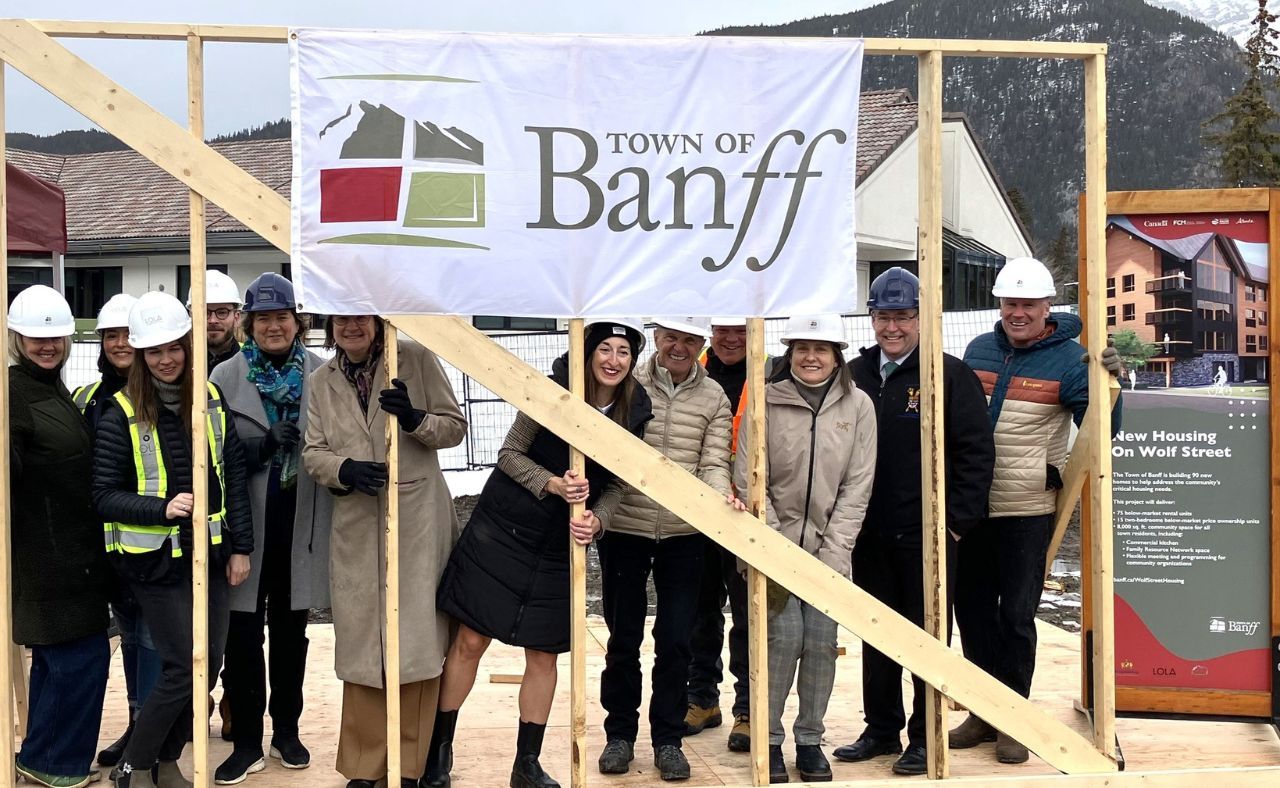
The Town of Banff officially broke ground Tuesday on a long-anticipated housing development at 50 Wolf Street, marking its largest municipally led housing project in more than a decade.
The $41.5 million project will deliver 90 homes for eligible Banff residents, alongside 8,000 square feet of new community space, on a centrally located site near the Bow River, Banff Mineral Springs Hospital, and Banff Park Lodge.
Town of Banff officials and project partners gathered for a ceremonial “wall raise” on March 17th to mark the start of construction, which is expected to continue through 2027.
“This project will provide more residents with a place to call home,” said Mayor Corrie DiManno, noting that many workers continue to leave the community due to a lack of housing.
A mix of rental and ownership housing

50 Wolf Street (Banff) - Concept Design
The development will include a combination of rental and ownership units, a first for a Town-led project in Banff.
Plans call for:
32 studio rental units
43 one-bedroom rental units
15 two-bedroom, price-restricted ownership units
Of the 90 homes, 75 will be offered as below-market rentals, while the remaining 15 will be sold at permanently below-market rates through the Banff Housing Corporation (BHC).
The BHC is a Town-owned entity that manages much of Banff’s below-market housing supply. Unlike typical real estate, where homes can be bought and sold at market value, BHC homes are tied to strict eligibility rules and resale controls. Buyers don’t purchase the land itself, and resale prices are capped or shared with the Town to ensure units remain affordable for future residents.
Once completed, the project will increase the corporation’s housing inventory by roughly 25%.
The homes will be built across two mid-rise buildings, with the first building expected to be ready for occupancy by late 2027.
Prospective buyers can already begin the process by applying through the Banff Housing Corporation’s Registered Resale List, while renters can add their names to the corporation’s rental waitlist ahead of the project’s completion.
Community space funded through private donation
A key feature of the development is a new community hub, funded through a $5 million contribution from the Wim and Nancy Pauw Foundation.
The space will include a shared kitchen, meeting rooms, and flexible programming areas intended for local organizations and residents.
In a statement, the foundation said the investment is aimed at strengthening community connections in a town where space for gathering has become increasingly limited.
“Supporting spaces like this is part of our mandate to nurture strong connections within our community and support initiatives that make the Bow Valley a better place to live, raise families, and enjoy mountain life,” the foundation said.
The project will also include public amenities such as washrooms and a water bottle filling station for users of the nearby Bow River trail system.
Built within tight limits
Banff’s housing challenges are shaped by unique constraints. The town’s population sits at roughly 9,000 residents within a fixed boundary of less than four square kilometres, with more than 98% of developable residential land already built out.
At the same time, vacancy rates remain effectively at zero.
Only individuals who live and work in Banff National Park are eligible to reside in the community, a federal requirement intended to preserve housing for the local workforce.
The new Wolf Street development is part of a broader effort to address a housing shortfall estimated between 700 and 1,000 units.
Who qualifies to live there
Eligibility for the new homes will follow existing BHC rules, which are designed to ensure housing remains tied to the local workforce.
To qualify, applicants must be Canadian citizens or permanent residents and meet one of several criteria tied to living and working in Banff National Park, including:
Being primarily employed within the park
Operating a business that requires a physical presence in Banff
Being a long-term resident who worked in Banff prior to retirement
Being a full-time student in the park, or a dependent of an eligible resident
Buyers must also agree to occupy the home as their primary residence and comply with resale restrictions that keep units permanently below market value.
Ownership units are typically sold at 20 to 30% below market rates, with resale price caps or shared-equity models in place to maintain long-term affordability.
Enabled by policy changes
Town officials say the project was made possible in part through recent changes under Banff’s Housing Action Plan, which aims to accelerate development and reduce regulatory barriers.
Those changes include removing minimum on-site parking requirements and allowing for higher-density development.
As a result, the Wolf Street project includes just 20 vehicle parking stalls and 180 bicycle parking spaces. Under previous rules, the same development would have required more than 100 parking spaces, making the project significantly more difficult to build and limiting space available for housing and community use.
The Housing Action Plan has already helped stimulate more than 600 housing units currently in the development pipeline, according to the Town.
A continuation of recent housing efforts
The Wolf Street project follows earlier Town-led developments, including the Ti’nu Apartments, which opened in 2018 with 131 homes, and The Aster, a 33-unit project completed in 2023.
Officials say the new development builds on lessons from those projects while introducing a broader mix of housing types and added community infrastructure.
Funding for the project comes from multiple partners, including $6.4 million from the Government of Alberta, $3.3 million from the federal Housing Accelerator Fund, and additional support from the Federation of Canadian Municipalities for a geothermal heating component.
The majority of the project, however, is being financed through debt. Of the roughly $41.5 million total cost, about $26 million will be borrowed.
Town documents show a portion of that debt, approximately $7.7 million, will be repaid in the short term through the sale of the 15 ownership units. The remaining $18.4 million will be financed over a 50-year period and paid back through rental revenue generated by the 75 below-market units.
Construction is now underway, with excavation and foundation work already beginning on the site’s east building.
When complete, the project is expected to add a new cluster of permanently below-market housing in one of the most constrained housing markets in the country.
Reply