- Bow Valley Insider
- Posts
- 15-Year-Old Ski Racer Killed in Avalanche at Nakiska Ski Area
15-Year-Old Ski Racer Killed in Avalanche at Nakiska Ski Area
The tragedy comes amid a cluster of avalanche deaths across Western Canada in the past two weeks

Bow Valley Insider
March 01, 2026

A teenage ski racer described by his community as driven and kind died Friday after an avalanche struck near Nakiska Ski Area, underscoring the volatility of a snowpack that forecasters had warned was primed for human triggering.
Avalanche Canada reported that a party of two was bootpacking up a northeast-facing slope at roughly 2,250 metres when they triggered a Size 2 wind slab. Both were caught. One was partially buried and able to survive; the other was fully buried. Rescuers located the buried skier and transported him to hospital, where he later died.
The victim has been identified as Emilio Hrazdira, a student at Queen Elizabeth High School and an athlete with the Alberta Alpine Ski Association.
In a statement posted to social media, the Alberta Alpine Ski Association said two of its athletes were involved in the Feb. 27 avalanche. “One athlete was able to self-rescue, while the second was buried,” the organization wrote. “After being rescued by first responders and the best efforts of emergency services, the athlete passed away after being transported to hospital.”
Alpine Canada echoed that grief. “We are devastated to learn that one of those young athletes has passed away,” the national body said, offering condolences to teammates, coaches and family.
The fatal slide occurred against the backdrop of a reactive avalanche cycle across Kananaskis and parts of British Columbia. Avalanche Canada warned Thursday that strong winds and new snow would likely trigger natural avalanches into Friday. In its public advisory, the agency cautioned that the snowpack remained “primed for human-triggering and capable of producing large, destructive avalanches.”
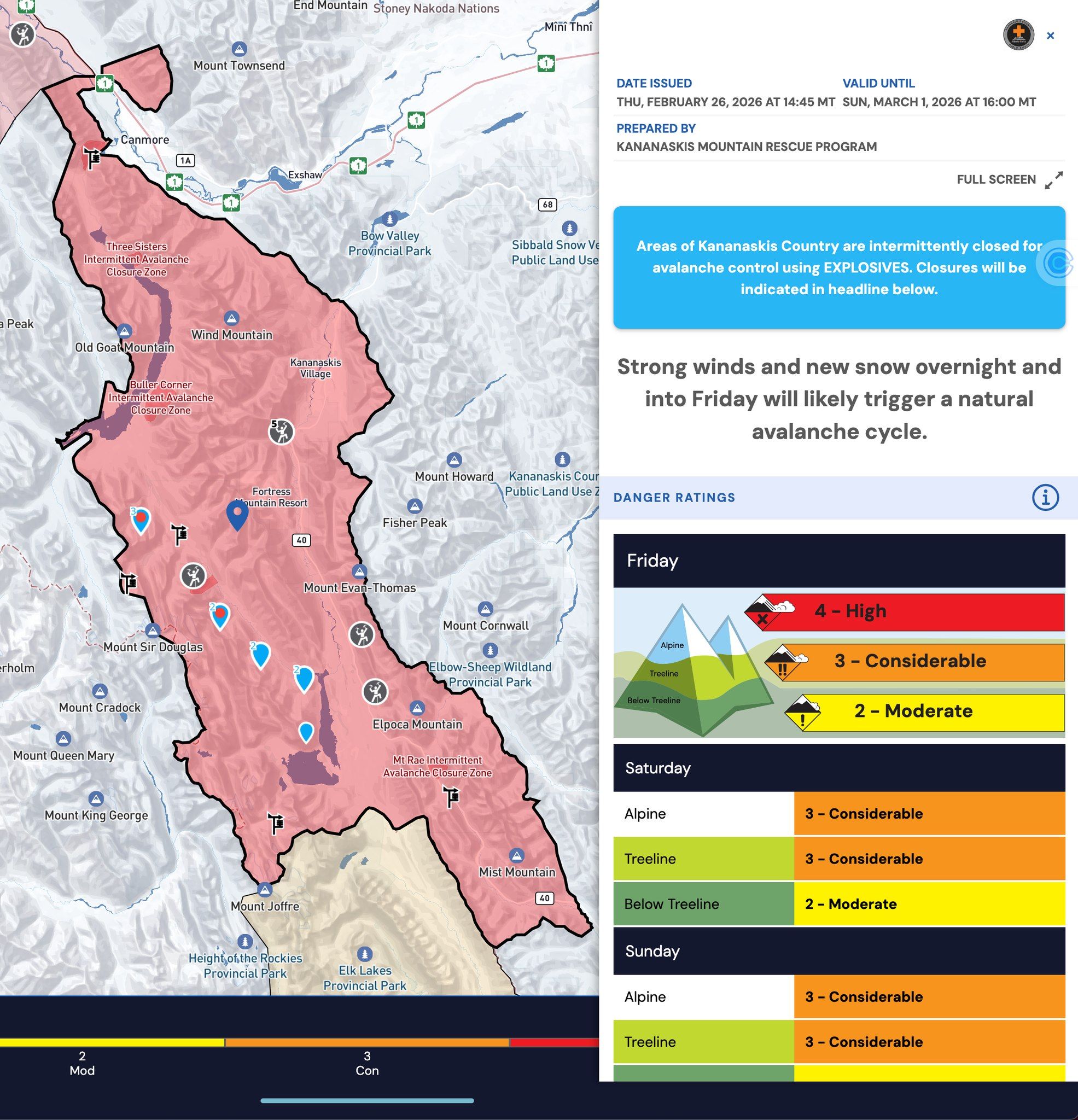
The regional forecast for Friday rated avalanche danger as High in alpine terrain, Considerable at treeline and Moderate below treeline. Wind slabs were listed as the primary problem, cohesive pillows of wind-drifted snow that can fracture under the weight of a person and propagate across a slope.
In recent days, user-submitted reports to Avalanche Canada’s Mountain Information Network have described several close calls in the same broader region. On Feb. 20, a skier remotely triggered a Size 2.5 wind slab near Hero’s Knob in Peter Lougheed Provincial Park and was struck from behind after the fracture propagated roughly 100 metres above. The skier deployed an airbag and was carried into a constricted section of the slope, suffering multiple injuries.
Two days later, on Feb. 22, two skiers were swept approximately 100 metres in a Size 1 wind slab in a north-facing bowl. Neither skier was buried.
Avalanche size ratings refer to the potential destructive force of a slide. A Size 1 avalanche is typically small but large enough to knock a person off their feet and carry them into hazardous terrain. A Size 2 avalanche is capable of burying, injuring, or killing a person. Avalanches rated Size 2.5 and larger can be powerful enough to damage vehicles or small buildings and cause significant destruction.
Those incidents, though non-fatal, reflected a pattern: wind-loaded features failing on buried crusts and weak interfaces left by mid-February sun and storm cycles.
Friday’s avalanche is the fifth fatal incident in Canada this season, and the fourth in just over two weeks. Deaths were also reported Feb. 17 at Matheson Creek, Feb. 19 near the Akolkolex River, Feb. 24 at Anniversary Glacier east of Pemberton, and Feb. 28 at Kootenay Pass. The clustering has alarmed forecasters and rescuers alike.
Avalanche Canada confirmed in a Facebook post Saturday that “several serious avalanche accidents have been reported…sadly including a fatal incident near the Nakiska ski area.” The organization urged backcountry users to consult forecasts carefully and adjust terrain choices accordingly.
Details about the precise location of Friday’s slide and whether it occurred within open, in-bounds terrain were not immediately clear. Bow Valley Insider asked Nakiska Ski Area to confirm the exact location, whether the athletes were participating in an organized training session, and what avalanche control work had been conducted in the area prior to the incident. The resort did not respond by publication deadline.
Nakiska is a hub for competitive alpine racing in Alberta and regularly hosts club training sessions throughout the winter. While avalanche control is routine within ski area boundaries, adjacent terrain and out-of-bounds slopes can present very different risk profiles, particularly during periods of high wind and fresh loading.
For families in the racing community, the distinction matters little in the face of loss.
“Our entire community is shaken by this event,” Alberta Alpine wrote, pledging to ensure “appropriate support is available to those affected.” The statement also thanked rescue teams, coaches and volunteers for their rapid response.
Reply